New Mud Volcano Emerges Off Trinidad and Tobago Coast After Venezuela Earthquakes
Scientists are studying a temporary mud volcano that emerged off Palo Seco after Venezuela's June 24 earthquakes, while satellite mapping and field surveys examine its origin and rapid coastal erosion.
19th of July 2026
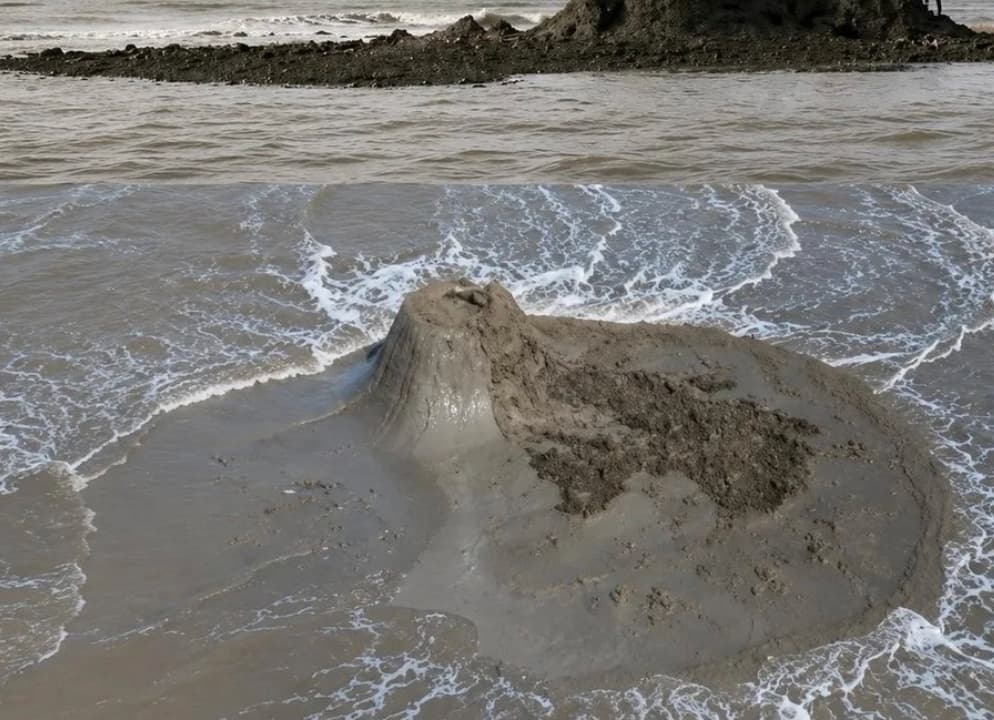
Trinidad and Tobago: A temporary mud island volcano has emerged from the sea off Trinidad’s southwestern coast at Palo Seco.According to scientists, the formation is believed to be the result of Venezuela's twin earthquakes that occurred on June 24
The island consists of soft clay and calcite-rich rocks and rises about 2.5 meters to 4 meters above the water and stretches around 2.5 km east of Beach Camp. It is rapidly eroding due to wave action.
According to information attributed to the University of the West Indies Seismic Research Centre (UWI-SRC), mud was expelled from the seabed following the seismic activity, leading to the creation of a temporary formation above the water.
Geoscientist Xavier Moonan has linked this event to powerful double earthquakes off Venezuela’s coast. These tremors are believed to have softened deep fault lines and caused the pressurised mixture of mud, gas, and clay to expel onto the seabed and also forced the parts of the coastline upward.
Researchers from the University of the West Indies Seismic Research Centre (UWI-SRC) and the Institute of Marine Affairs are studying the area.
Teams are collecting rock and mud samples to analyze the age and deep geological origin of the ejected materials.
The NASA-ISRO Synthetic Aperture Radar (NISAR) satellite is also mapping the exact surface ground shifts across the region to help better understand the rupture dynamics.
Since the formation sits low and is made of unconsolidated sediment, strong ocean currents and heavy wave action are already eroding the island.
Moreover, Trinidad & Tobago consists of about two dozen documented mud volcanoes, and scientists have anticipated continuous geological monitoring.
Mud volcanoes are different from the more commonly known volcanic systems that erupt molten rock or lava. Mud volcanoes generally form when underground pressure forces mixtures of mud, water and gases upward through weaknesses in the Earth’s surface.
Latest
- Nevis releases Cruise Ship Schedule for November 2026 to January 2027
-
St. Kitts and Nevis: Acting PM Hanley highlights Jobs, Economic Growth and Cost-of-Living Support in 2027 Budget -
Caribbean Airlines offers reduced fares between Trinidad and four Caribbean destinations -
Janice Jean-Jacques Thomas to be honoured for contributions to Dominica’s Social Security System -
Guyana: Police recover missing six-year-old Orlando Jaikarran’s body; Father admits killing
Related Articles

29th of October 2023

20th of August 2023


11th of January 2021